
September 25, 2026
Demonstrative Exhibits: Using Visuals to Clarify Complex Evidence at Trial
-
Legal
-
Insight

Key Takeaways
Demonstrative exhibits are visual, physical, or digital materials used in court to clarify testimony and other evidence. Common examples include animations, anatomical models, charts, timelines, and diagrams. In complex cases, such as a spinal fusion malpractice trial or a multi-vehicle crash reconstruction, these tools help a judge or jury understand evidence or arguments that would otherwise take thousands of words of oral testimony to convey.
Under the Federal Rules of Evidence, demonstrative evidence must be relevant, accurate, and properly grounded in the evidentiary record. Federal Rule of Evidence 107, which took effect December 1, 2024, now formally distinguishes illustrative aids from admitted evidence, and it controls whether visuals travel back with the jury during deliberations.
MediVisuals + High Impact creates medically and scientifically accurate trial graphics, 3D reconstructions, and forensic animations that turn dense medical records and technical data into clear visuals jurors can absorb in minutes. Demonstrative exhibits are most persuasive when they align tightly with the case theory, conform to the rules of evidence, and are designed from the outset to survive admissibility challenges.
The sections below walk litigators through definitions, the interplay of demonstrative evidence and illustrative aids, federal rule developments, strategic design choices, and practical checklists for real trials and jury deliberations.
Introduction: Demonstrative Exhibits and Modern Trial Practice
Imagine a 2024 product liability trial involving a catastrophic tire bead failure. The engineering testimony covers metallurgy, rim deformation sequences, and stress fracture propagation. Without visuals, jurors would struggle to connect each witness's testimony to a coherent story. A single 3D animation showing the bead separating from the rim under load replaced what could have been hours of dense oral testimony with a clear, 90-second visual image that jurors referenced repeatedly.
Demonstrative exhibits include physical models, medical illustrations, crash reconstruction sequences, and interactive screens used alongside live and deposition testimony. They summarize complex information visually to aid comprehension, and they give jurors a way to anchor abstract concepts in something concrete.
Research supports this approach. According to a study cited by the Louisiana Transportation Research Center, jurors retain roughly 65% of information delivered visually and orally combined, compared to just 10% when information is presented through speech alone. A University of Minnesota study found presentations using visual aids are approximately 43% more persuasive than those without.
MediVisuals + High Impact serves as a litigation support partner that builds scientifically accurate visual strategies. We are not a law firm or a testifying entity. Our focus is on evidentiary soundness and clear storytelling that helps attorneys present their client's case with confidence. The rest of this article connects demonstrative exhibits to demonstrative evidence, illustrative aids, and the recent federal rule developments that impact what the jury can see and use.
Cinematic summary of injuries.
Substantive, Demonstrative, and Illustrative: Getting the Categories Right
Correct classification of an exhibit affects its foundation, admissibility, use at trial, and treatment on appeal. Getting the category wrong can mean the difference between a visual that goes to the jury room and one that gets excluded entirely.
Substantive exhibits have independent probative value in court. They contain the proof itself. A 2023 CT scan admitted as substantive evidence in a traumatic brain injury case, a defective steering column produced during discovery, or original design drawings in a patent suit are all examples of documentary evidence or physical evidence that prove facts directly.
Demonstrative exhibits are visual or physical representations that illustrate facts but do not serve as independent evidence. A 3D-printed femur showing a comminuted fracture pattern, or a scaled roadway model depicting an intersection collision, helps prove or disprove a fact when paired with testimony. Only substantive and demonstrative exhibits can be admitted into evidence under the applicable evidence rules.
Illustrative aids assist understanding but lack independent probative value. A timeline slide of events leading up to a surgery, or a labeled anatomical diagram used during a surgeon's testimony, simply helps the jury follow what a witness is saying. Illustrative aids are not considered evidence in court, and under Federal Rule 107, they must not be provided to the jury during deliberations unless specific conditions are met.
Each category is treated differently under rules governing relevance, hearsay, and authentication. The sections that follow connect these definitions to Rule 107, admissibility foundations, and jury deliberation strategy.
Demonstrative Evidence: When Visuals Themselves Have Probative Value
Demonstrative evidence is not just any picture on a screen. It is a demonstrative exhibit that the trial court allows to be treated as evidence because it helps make a disputed fact more or less probable. Demonstrative evidence enhances oral testimony, though it does not replace the underlying evidence it depicts.
Concrete examples include a forces diagram in a crash reconstruction that independently supports a biomechanical conclusion, a scale model of a guardrail in a highway defect case, or a forensic animation depicting collision dynamics. In People v. Douglas (2016, Colorado Court of Appeals), three animated videos were admitted as demonstrative evidence because they were supported by witness statements, physical measurements, and reflected the conclusions of a qualified expert witness. The court applied a four-factor test covering authentication, relevance, fair and accurate representation, and probative value versus prejudice.
Courts look for a close factual fit between the demonstrative and the underlying conditions. Under the general relevance standard of Federal Rule of Evidence 401, the visual must make a fact of consequence more or less probable. Photographs and videos that document accidents or injuries also fall within this category when they accurately portray the scene or condition at issue.
Demonstrative evidence often requires testimony from a treating physician, engineer, or reconstruction specialist who can establish that the exhibit fairly and accurately depicts what it purports to show. This is the proper foundation requirement.
Once admitted, demonstrative evidence is typically available for the jury's review during deliberations, which amplifies its strategic importance. Demonstrative exhibits do not prove a fact by themselves, but their presence in the deliberation room can reinforce the key facts jurors need to reach a verdict.
Illustrative Aids: Powerful Tools That Are Not Evidence
While demonstrative evidence carries probative value, illustrative aids serve a different function. They support assisting comprehension but are not admitted as proof of facts. Illustrative aids have no independent probative value.
Specific examples used in cases from 2018 through 2026 include liability timelines, surgery step flowcharts, color-coded damages charts that track already admitted spreadsheets, and a chart summarizing medical billing records. Each one helps explain testimony without introducing new facts.
Demonstrative aids are used during opening statements, witness examinations, and closing arguments, subject to the court's discretion. They often incorporate admitted exhibits, deposition excerpts, or stipulations. An illustrative exhibit might display an annotated diagram while a surgeon explains a procedure, helping visual learners in the jury follow complex testimony.
Because illustrative aids are not evidence, they are usually not taken into the jury room. Under Federal Rule 107, illustrative aids cannot be provided to juries during deliberations unless all parties consent or the court finds good cause. They must also be entered into the record when practicable.
A practical tip: litigators should draft brief limiting instructions for the court, making clear to jurors that certain visuals are teaching tools only. This reduces appellate risk and helps jurors separate the visual aid from the admitted evidence it was designed to explain or clarify.

Medical illustration showing summary of injuries.
Federal Rule 107 and Related Rules: How Federal Courts View Visuals
Federal Rule of Evidence 107, adopted and effective December 1, 2024, provides the first uniform federal standard governing illustrative aids. The new rule codifies that illustrative aids used solely to help the jury understand evidence are not themselves evidence. Before this rule, courts in the federal system made ad hoc, case-by-case determinations under Rules 401, 403, and 611.
Rule 107 interacts with long-standing provisions. Rule 611 governs trial management, and Rule 403 requires the familiar balancing test: an aid's utility in assisting comprehension must not be substantially outweighed by risks such as unfair prejudice, confusing issues, misleading the jury, undue delay, or wasting time.
It is important to contrast Rule 107 illustrative aids with Rule 1006 summaries. Rule 1006 permits summaries of voluminous materials, such as a multi-year billing ledger or thousands of pages of maintenance logs, to be admitted as substantive evidence. A Rule 1006 summary can go into the jury room as evidence; a Rule 107 illustrative aid generally cannot.
Under Rule 107, visuals may be permitted into the jury room only when all parties consent or the court finds good cause. This distinction matters for how MediVisuals + High Impact designs demonstratives. When an animation is built to qualify as admitted evidence rather than a mere illustrative aid, it must meet higher foundational requirements, but the payoff is access to the jury's understanding during deliberations. The advisory committee notes accompanying the rule confirm this framework.
Attorneys must also check state evidence codes. Some states have adopted rules similar to the federal approach, while others still treat demonstrative exhibits under more general rules of evidence.
Admissibility Foundations: Relevance, Accuracy, and Rules of Evidence
Even the most compelling demonstrative exhibit must be built to survive challenges under the rules of evidence. Otherwise, it may be limited to use as an illustrative aid or excluded altogether, raising serious admissibility concerns.
The basic relevance standard requires that the demonstrative make a fact of consequence more or less probable. A 2022 orthopedic animation that depicts the precise surgical hardware and injury pattern at issue, rather than a generic skeleton, satisfies this requirement. Demonstrative exhibits must be relevant and authentic to be admitted.
Authentication works in practical terms through sponsoring witnesses. A surgeon can testify that an animation accurately portrays MRI findings from a specific date; an accident reconstruction specialist can confirm that a sequence matches event data recorder outputs. The same person who testifies about the underlying evidence is often best positioned to lay foundation for the visual.
The probative-versus-prejudicial balancing test matters here. A graphic burn-injury close-up or slow-motion animation might need to be tailored, cropped, or de-emphasized to reduce the risk of unfair prejudice or cumulative impact. Courts regulate demonstrative exhibits to ensure they are not misleading or prejudicial, and in People v. Palacios, the court considered whether minor discrepancies affected admissibility or merely weight.
Hearsay concerns arise when a demonstrative contains out-of-court statements, embedded labels, quotes, or summaries. Content must mirror admitted records or a witness's testimony to avoid hearsay problems and ensure an accurate depiction of the underlying evidence.
Common Types of Demonstrative Exhibits in High-Stakes Litigation
MediVisuals + High Impact routinely supports complex medical malpractice, product liability, crash reconstruction, and intellectual property matters with tailored demonstratives. Attorneys use demonstrative exhibits to simplify dense technical and complex information across all of these practice areas.
Common categories include:
- Medical illustration boards showing procedures like a cervical discectomy, with surgical step sequences and comparative "before and after" anatomy correlated with specific radiology dates. Anatomical models visually demonstrate medical evidence related to personal injury cases, and medical illustrations help jurors visualize injuries that are difficult to understand verbally.
- Forensic animations depicting motor vehicle collisions, including 18-wheeler underride crashes, intersection collisions, and seat belt injury mechanisms. Demonstrative exhibits can be used in litigation to visualize accident reconstructions.
- Patent claim diagrams for semiconductor processes or mechanical inventions, and technology timelines for IP disputes.
- Life-care-planning charts projecting costs through 2050, and damages models blended into simple charts jurors can quickly interpret. Timelines and charts organize complex events or data for better jury comprehension, and maps and diagrams clarify spatial relationships important in cases like traffic accidents.
In product liability and industrial cases, 3D exploded views, failure progression animations, or process line schematics help jurors understand how a machine guard, valve, or tire component failed. Environmental and commercial damages visuals, such as time-series contamination maps, round out the toolkit.
Interactive presentation showing summary of head injuries and surgeries.
Designing Demonstrative Exhibits: From "A Picture Is Worth a Thousand Words" to Trial-Ready Visuals
Effective demonstrative exhibits apply communication science, not just graphic design. Each visual should replace a thousand words of dense testimony with a single clear scene or diagram. Visual aids help jurors remember details better than verbal testimony alone, and they help visual learners connect emotionally with the case.
Key layout principles include:
- Simplicity. Limited text, large type, and clean color palettes ensure a juror in the back row can absorb a damages bar chart in seconds.
- Sequential panels. A 4-step laparoscopic procedure unfolds in labeled frames rather than a single cluttered image.
- Side-by-side comparisons. Contrasting "plaintiff theory" and "defense theory" diagrams of a 3-car collision gives jurors a clear framework for evaluating competing narratives.
- Scale and legends. Visible markers and citations to exhibit numbers and transcript pages anchor every frame to the record.
MediVisuals + High Impact integrates data sources like DICOM datasets, CAD files, police diagrams, and deposition transcripts to ensure scientific and technical accuracy at the pixel and frame level. Visuals can significantly enhance jurors' understanding of complex facts when they are grounded in real case data.
Early collaboration between trial counsel and the visual team during discovery ensures that demonstratives are aligned to the case themes and key elements, not bolted on at the last minute.
Strategic Use of Demonstratives Throughout the Life of a Case
Demonstrative exhibits are not reserved for live trial. They influence case evaluation, mediation, and settlement from the first strategy session through verdict. Their practical implications extend well beyond the courtroom.
In pre-suit and early-case phases, a rough anatomy illustration or crash sequence storyboard can help evaluate damages and liability, or facilitate early mediation. Benefits of legal animations include shaping case themes long before trial.
During trial, demonstratives can structure examinations. A master timeline board anchors a treating physician's testimony. A labeled mechanism-of-injury chart grounds biomechanical testimony. Demonstrative exhibits clarify or dramatize testimony during legal proceedings and help the fact finder understand the evidence.
In opening statements and closing arguments, counsel must decide which exhibits will be offered as demonstrative evidence versus employed purely as illustrative aids under Federal Rule 107 or comparable state rules. Presenting evidence with a clear classification strategy avoids mid-trial surprises.
Demonstratives designed with jury deliberations in mind, such as neutral damages tables or stepwise causation diagrams, are more likely to be allowed back with jurors and other exhibits, amplifying their impact when verdicts are decided.
Legal and Ethical Guardrails: Avoiding Misleading or Overly Persuasive Visuals
Courts are increasingly sensitive to the risk that computer animations, simulations, and graphic medical imagery may unfairly sway jurors if not carefully tied to the evidence. An appellate court may reverse a verdict if visuals were misleading or inflammatory.
Common objections include claims that an animation resembles a theatrical reenactment rather than an evidence-based depiction, or that color enhancements of CT scans exaggerate pathology. Opposing counsel may argue that the visual's prejudicial impact is substantially outweighed by any probative value it offers.
MediVisuals + High Impact grounds every visual in objective data, using legends, scale markers, and citations to exhibit and transcript page-and-line numbers so that each frame can be traced to the evidentiary record. This approach produces an accurate depiction that withstands scrutiny.
Ethical considerations include avoiding speculative depictions (such as hypothetical future surgeries) unless clearly labeled and grounded in disclosed medical opinions, and refraining from adding dramatizing elements like background music. Building conservative, accurate visuals supports the integrity of the verdict on appeal and ensures that the presentation does not prove more than the record supports.
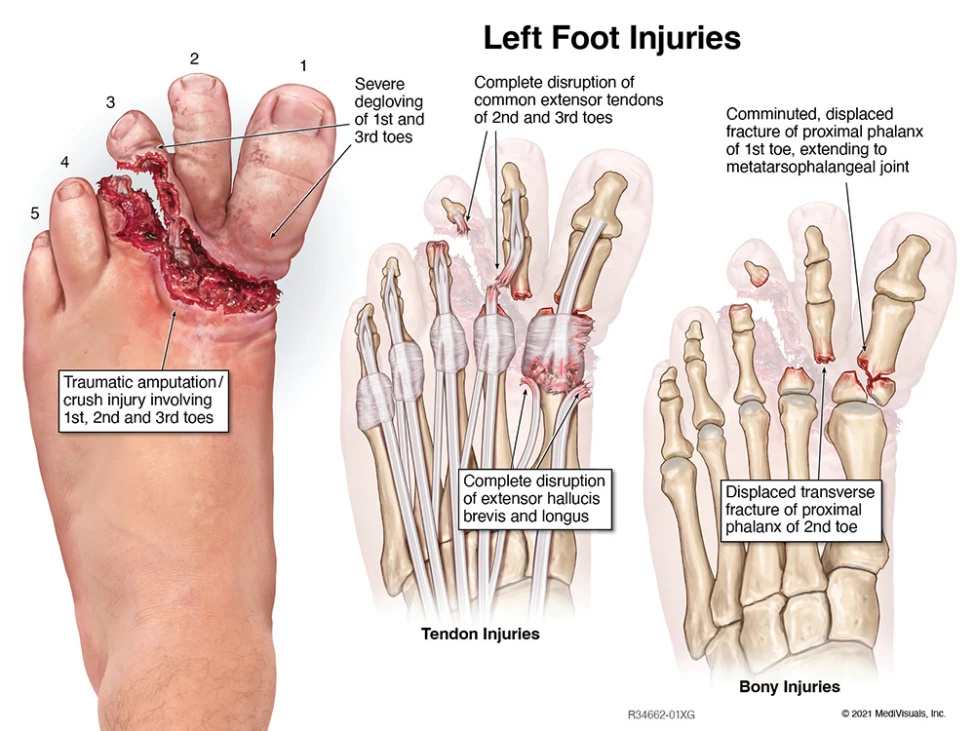
Medical illustration showing left foot injuries.
Working With MediVisuals + High Impact on Demonstrative Exhibits
MediVisuals + High Impact serves as a B2B litigation support partner, collaborating with trial teams on medical illustration, forensic animation, trial graphics, crash reconstruction, and intellectual property visuals for cases filed in state and federal courts.
A typical engagement flows from initial case intake and review of medical records or electronic data, through storyboarding, draft reviews with the trial team, and final production of trial-ready exhibits. The team coordinates with retained medical professionals, engineers, or accident reconstruction specialists to validate the accuracy of anatomical details, kinematics, or mechanical sequences before anything is shown in court.
Logistical support includes preparing alternate versions of demonstratives, "clean" and "annotated" copies, and quick-edit capabilities to adapt to evidentiary rulings that occur mid-trial. MediVisuals + High Impact also helps attorneys determine whether a given visual is best positioned as demonstrative evidence or as an illustrative exhibit under applicable rules, to maximize its time in front of the jury.
Practical Checklist: Preparing Demonstrative Exhibits for Trial and Jury Deliberations
Preparing demonstrative exhibits for trial is a structured process. The following framework walks litigators from early planning through the start of jury deliberations.
120+ days before trial:
- Identify key issues that need visuals and the complex testimony that requires illustration.
- Decide which items should be offered as demonstrative evidence versus illustrative aids.
- Map each proposed exhibit to specific witnesses and transcript cites, and begin data collection.
60 days before trial:
- Exchange demonstrative exhibit lists with opposing counsel.
- File motions in limine addressing admissibility of animations, timelines, and charts.
- Address Federal Rule 107 issues and obtain tentative rulings where possible.
14 days before trial:
- Finalize all demonstrative and illustrative materials.
- Rehearse direct examination that uses each visual.
- Prepare printed backups in case of technical failure, and confirm courtroom technology compatibility.
Day of trial and deliberation preparation:
- Mark each demonstrative clearly for the record.
- Note on the record whether each item was admitted into evidence or used solely as an illustrative aid.
- Confirm with the court and opposing counsel what, if anything, will go back to the jury during deliberations.
This practical framework ensures that no exhibit falls through the cracks and that the record is clean for appeal.
Summary and Forward-Looking Considerations
Demonstrative exhibits, when correctly classified and grounded in the rules of evidence, can transform complex medical, technical, and economic issues into visuals that jurors can grasp quickly and remember during deliberations. Demonstrative evidence clarifies witness testimony for jurors, and illustrative aids help jurors follow arguments they might otherwise miss.
The distinction between demonstrative evidence and illustrative aids is now codified in Federal Rule 107, which controls whether visuals travel to the deliberation room. Litigators who plan around this distinction gain a structural advantage.
Scientifically accurate animations, medical diagrams, and trial graphics that can stand as compelling evidence, not background decoration, are essential in high-stakes litigation. Demonstrative exhibits enhance jury comprehension and retention in ways that oral testimony alone simply cannot match.
Emerging trends through 2026 include increasing use of 3D interactive exhibits, virtual reconstructions, and physics-based simulations. Partnering with MediVisuals + High Impact helps trial teams navigate both the technical and evidentiary challenges of this evolving landscape, ensuring that every visual is admissible, accurate, and built to persuade.
Frequently Asked Questions
The questions below address practical issues trial lawyers frequently raise about demonstrative exhibits, demonstrative evidence, and illustrative aids.
Are demonstrative exhibits automatically allowed into the jury room during deliberations?
Not automatically. Demonstrative exhibits admitted as evidence, such as an animation treated as demonstrative evidence, are often allowed into the jury room, but courts retain discretion and may exclude visuals that risk undue emphasis. Illustrative aids governed by Federal Rule 107 are not evidence and may only be taken into the deliberation room if all parties consent or the court finds good cause. Early planning about how an exhibit will be classified is critical to maximizing its impact.
How early in a case should I start planning demonstrative exhibits?
Planning should begin as soon as counsel identifies complex medical, technical, or damages issues that will need visual explanation, often months before trial. Data collection, review by a retained expert witness, and rules-of-evidence strategy all take time. Early collaboration with MediVisuals + High Impact helps ensure that visuals are aligned with the case theory and discovery plan, instead of being rushed on the eve of trial.
Can a single visual be both an illustrative aid and demonstrative evidence?
Yes. The same underlying graphic or animation can be used initially as an illustrative aid to assist understanding and help a witness explain concepts, then later formally offered and admitted into evidence as demonstrative evidence if it meets the applicable rule requirements. Counsel must clearly state on the record how the exhibit is being used at each point so that the court, jury, and any appellate court understand whether it is evidence or simply a tool to assist understanding.
What data should I provide to support a medically accurate animation or illustration?
Common materials include operative reports with dates, radiology films and DICOM files, clinic notes, biomechanical reports, engineering drawings, and photographs from the scene. All materials should be tied to specific case dates and events. The more complete and specific the source material, the easier it is for a visual team to create a demonstrative that is both persuasive and defensible under evidentiary scrutiny.
Do courts view computer animations differently from static graphics?
Many courts scrutinize computer animations more closely because moving images can feel like reenactments. Judges often require strong foundations tying each movement to established data, such as event data recorder outputs or motion analysis. Static diagrams or photos may be more readily admissible but may not convey time and sequence as effectively. Counsel should weigh these tradeoffs when deciding how to present evidence and whether an animation or static graphic better serves the case.
Work with us
Interested in working with us? To get started choose one of the options below.