
August 22, 2026
Legal Graphics: A Practical Guide to Medical-Legal Illustrations for Litigation
-
Illustration
-
Medical Illustration
-
Legal
-
Insight
- +2

Legal graphics and medical legal illustrations translate complex medical and technical evidence into visuals that jurors, mediators, and adjusters can process in minutes rather than hours. For attorneys handling catastrophic injury, medical malpractice litigation, product liability, or crash reconstruction, these visuals often determine whether a jury grasps causation, severity, and damages. This guide covers what legal graphics are, how they differ from textbook medical illustrations, and how attorneys can work with MediVisuals + High Impact to create case specific illustrations that hold up in court.
Key Takeaways
- Legal graphics are visual aids designed to make complex information clear and persuasive for lay audiences in trial, mediation, and settlement.
- Medical legal illustrations differ from textbook anatomy art because they are built from the actual patient's imaging and records, simplified for a jury rather than packed with detail for clinicians.
- Attorneys, medical professionals, and highly trained medical illustrators collaborate through an iterative review process to produce anatomically accurate exhibits.
- Custom medical illustrations can impact trial outcomes in cases involving contested causation, multiple surgeries, or seven- and eight-figure exposure.
- The game plan for presenting legal graphics matters as much as the graphics themselves; timing, foundation testimony, and technology backups are all essential.
What Are Legal Graphics and Medical-Legal Illustrations?
Legal graphics are visual tools used in U.S. litigation, arbitration, and mediation to help judges and juries process complex data quickly and retain important facts. Medical legal illustrations are a subset focused on human anatomy, pathology, surgical procedures, and injury mechanisms. They reduce cognitive load by presenting intricate information as visual elements rather than verbal descriptions alone.
Concrete examples include:
- A medical illustration of a 2024 cervical fusion showing hardware at C5-C6
- A 3D animation of a 2022 rear-end collision depicting occupant kinematics and vehicle deformation
- A timeline graphic of a 2020 sepsis misdiagnosis charting lab errors, treatment delays, and outcomes
- A cutaway view of a 2025 consumer appliance in a product liability case
Unlike medical illustrations found in journals or textbooks, medical legal illustrations are created for lay audiences. They simplify complex medical issues for juries and adjusters rather than clinicians. MediVisuals + High Impact provides end-to-end visual strategy, from initial case review through final trial exhibits, across four main categories:
- Medical legal illustrations (injury, surgery, mechanisms)
- Legal illustration for non-medical topics (contracts, IP diagrams)
- Forensic animation (crash reconstruction, crime scenes)
- Trial graphics (timelines, charts, demonstrative aids)
Medical Illustrations vs. Medical-Legal Illustrations
Conventional medical illustration is designed for medical education. Medical legal illustrations are designed for clarity in the courtroom. The difference is not cosmetic; it determines whether a jury can follow what happened to the plaintiff.
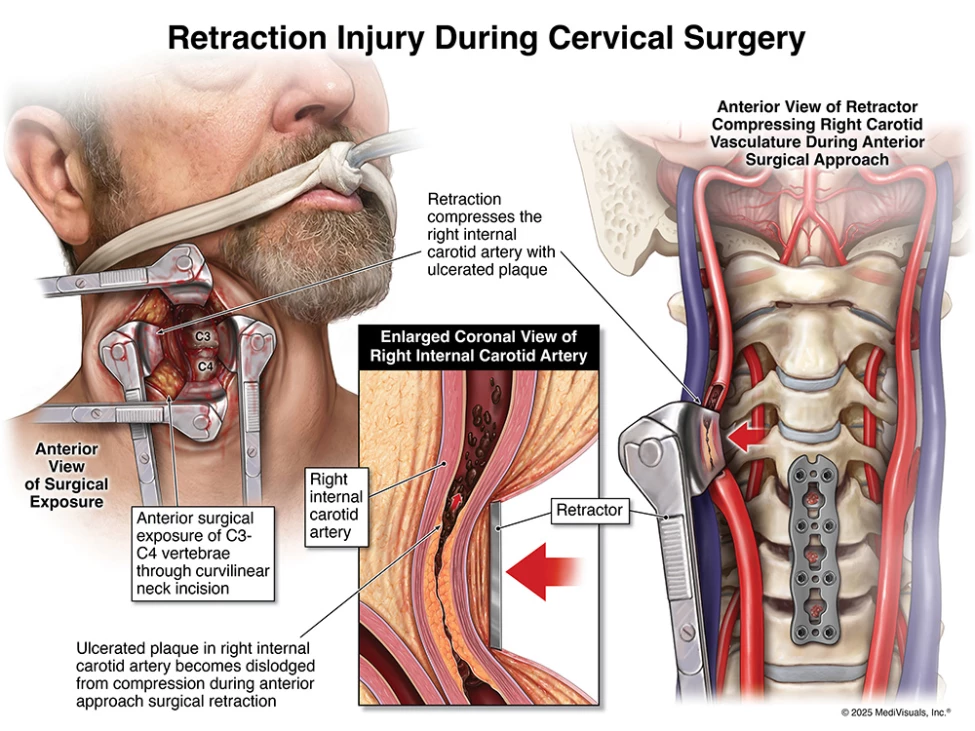
Retraction Injury During Cervical Surgery
Textbook-style features attorneys should recognize:
- Dense labeling of every nerve, vessel, and muscle
- Multiple cross-sections and pathologies on one page
- Neutral presentation typical of anatomy atlases used in 2010-2026 medical schools
Medical legal illustrations strip that complexity down:
- Selective labeling focused on the injury at issue (e.g., L4-L5 disc herniation after a 2023 workplace fall)
- Clear before-and-after comparisons
- Single-event focus tied to specific operative reports and radiology studies
Where generic plates fail: taking a spine plate from a 2005 atlas and hand-drawing in herniated discs invites cross-examination. Defense counsel can argue the image does not depict the plaintiff's actual anatomy or pathology. Case specific illustrations built from the patient's own CTs, MRIs, and operative notes, with each detail validated by a treating or consulting physician, avoid that vulnerability. Medical illustrations must be anatomically correct and simple enough that complex illustrations do not confuse lay juries or hinder comprehension.
How Legal Graphics Support Litigation Strategy
Legal graphics function as a storytelling framework, guiding jurors through liability, causation, and damages. Well-designed legal graphics present a coherent narrative that reinforces the case theme while organizing facts to guide viewers toward logical conclusions without misrepresentation.
- Visual aids help jurors understand the mechanism of injuries in a 2021 truck crash by showing force vectors on the spine
- Timelines display the chronological order of events to clarify sequences in a 2019 stroke misdiagnosis, showing missed treatment windows
- Charts and graphs simplify complex financial or statistical data in life-care plans and damages summaries
- Diagrams illustrate relationships among entities or processes, such as the steps in a 2022 hip implant revision surgery
- Document callouts highlight crucial text within medical records to draw focus during presentations
Medical legal illustrations can visually separate pre-existing degenerative conditions from acute trauma. A common use: distinguishing chronic lumbar degeneration (osteophytes, disc narrowing) from a new disc herniation caused by a 2024 rear-end collision. Visual aids improve information retention and help juries remember critical details during deliberations. 3D models and animations created from DICOM data reveal subtle internal injuries, such as small subdural hematomas or ligament tears, that are nearly impossible to appreciate from grayscale films. Custom medical illustrations can impact trial outcomes when causation is the central dispute.
Types of Legal Graphics Used in Medical-Legal Cases
MediVisuals + High Impact produces several categories of visuals for medical legal cases and technical disputes.
- Medical illustrations: Pre- and post-injury anatomy plates from 2022 orthopedic cases; step-by-step surgical sequences for a 2020 laparoscopic cholecystectomy; infection progression charts in 2023 sepsis cases. These serve as visual translations of expert opinions.
- Medical malpractice visuals: ER timeline graphics, charts of missed diagnostic criteria, overlays showing needle misplacement during a 2021 epidural injection.
- Crash reconstruction and forensic animation: 3D recreations of a 2022 intersection collision, daytime/nighttime visibility comparisons, speed and braking-distance diagrams. 3D animations recreate dynamic events to enhance understanding, and custom 3D animations depict surgical procedures and injury mechanisms with views unmatched by traditional 2D imaging. Medical illustrators create 3D models from patient imaging data.
- Environment and product liability: Guard-removal diagrams on a 2019 industrial machine, cutaways of a 2020 consumer appliance, slip-and-fall path-of-travel illustrations for a 2023 premises case.
- Intellectual property visuals: Process flow diagrams for a patented 2018 medical device, exploded views of components in a 2020 technology patent, side-by-side product comparisons.
Collaborating With Medical-Legal Illustrators
Effective legal illustration depends on close collaboration between attorneys, medical professionals, and the visual team at MediVisuals + High Impact. Medical illustrators collaborate with attorneys and medical experts throughout the creation process, and illustrators review expert reports and clinical records for accuracy before any drawing begins.
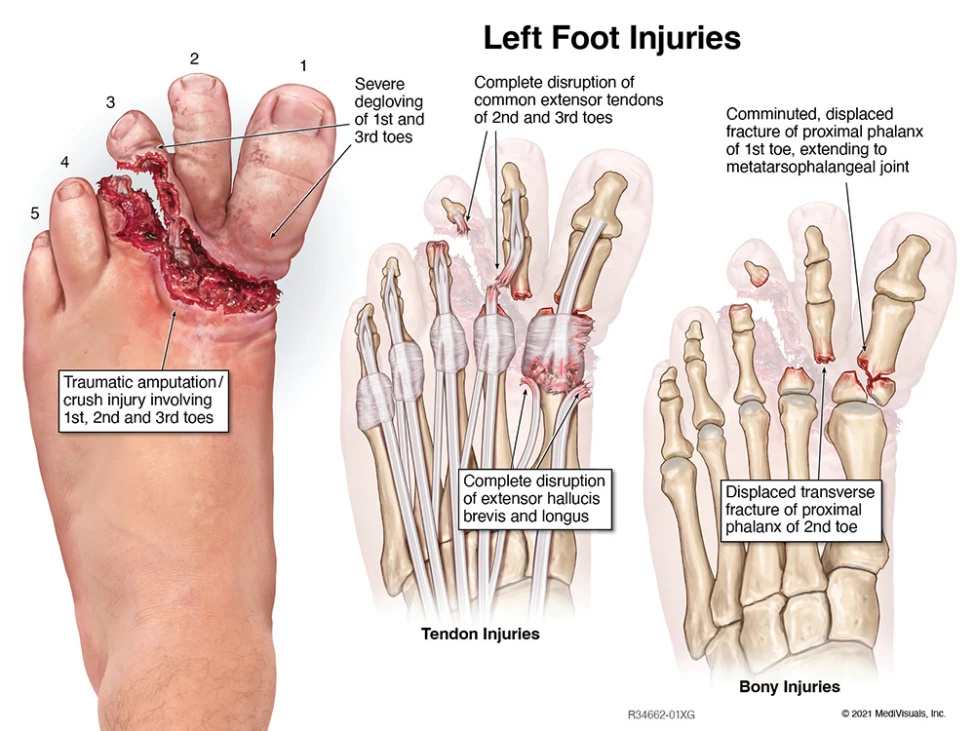
Medical illustration showing severe injuries to the toes.
Practical workflow:
- Initial consultation (30-60 minutes): Define the area of dispute, whether liability, causation, or damages, and establish the extent of visual support needed.
- Record transfer: Gather operative notes, radiology reports, imaging studies in DICOM format, deposition transcripts, and the client's prior medical history.
- Analysis: The illustrator reviews the clinical sequence from 2018-2026 case records to identify the anatomy and events that must be depicted.
- Iterative review: Rough pencil or digital sketches are shared with counsel and physicians. Mark-ups address terminology (choosing "ACL tear" vs. "anterior cruciate ligament rupture"), label count, and orientation. Graphics must be used carefully to ensure they accurately represent underlying evidence.
- Sign-off: Final medical legal illustrations are not released until the relevant physician confirms accuracy, supporting credibility and admissibility in both federal and state courts.
When to Invest in Custom Medical-Legal Illustrations
Custom legal graphics are an investment. They make sense when visual clarity can move the needle on case value or outcome.
- Case types: Catastrophic spinal cord injury from a 2021 rollover, birth trauma cases filed in 2020, complex cardiac surgery malpractice, multi-level orthopedic injuries with hardware revisions
- Decision criteria: Seven- or eight-figure exposure; contested causation where imaging is central; multiple treating providers over several years; confusing operative histories with complications
- Mediation and settlement: A clear sequence of a 2019 lumbar fusion or 2023 traumatic brain injury helps carriers and opposing counsel grasp risk quickly, often shortening negotiation time
- Hybrid approach: Attorneys sometimes use modified stock images showing normal anatomy for context, then add a limited number of custom boards for the most critical disputed issues when budget is constrained
Best Practices for Presenting Legal Graphics in Court
How legal graphics are used at trial or in mediation matters as much as the graphics themselves. An impactful presentation follows a checklist.
- Pair a radiology film (MRI from 2022) side-by-side with its corresponding medical illustration on screen; have the treating physician identify the images and confirm the illustration's accuracy for the jury.
- Use broad overview graphics in opening statements, detailed surgical sequences during testimony, and summary boards in closing arguments to refresh juror memory.
- Prepare foundation testimony: explain which records were reviewed, who created the exhibits, and that the visuals are fair, accurate representations of the underlying evidence. Under Federal Rule of Evidence 107, effective December 1, 2024, illustrative aids are subject to a balancing test weighing utility against unfair prejudice.
- Test compatibility with 2026 courtroom presentation systems. Bring printed boards as backups. Ensure color reproduction is consistent and nothing appears exaggerated on screen.
FAQ
How are medical-legal illustrations different from simply enlarging an MRI or CT scan?
Raw imaging studies from modern scanners are grayscale and present many structures irrelevant to the case. Non-medical viewers find them difficult to interpret without training. Medical legal illustrations translate those scans into color, perspective, and simplified anatomy, showing only the structures that matter for liability and damages. A jury will typically understand a clear cross-section of an injured disc faster than a DICOM slice displayed on its own.
Can legal graphics be used during mediation even if the case never goes to trial?
Many projects at MediVisuals + High Impact are created for mediation or settlement conferences, not jury trials. Clear visuals give adjusters and risk managers a rapid understanding of injury severity, and exhibits prepared for mediation can often be refined and reused if the case proceeds to trial. Learn more about legal graphics for trial and mediation.
What materials should an attorney gather before contacting a medical-legal illustrator?
An attorney should collect hospital and clinic records from the incident date forward, operative reports, radiology reports, imaging studies in DICOM format, and any prior medical records relevant to pre-existing conditions. Include key deposition transcripts and a brief case summary highlighting disputed issues. Providing organized digital files from the outset shortens turnaround time and reduces revision cycles.
How long does it usually take to produce custom medical-legal illustrations?
Simple single-injury boards can be completed in days once records are in hand. Multi-surgery sequences or 3D animations for recent cases may require four to eight weeks from approved concept to final delivery. The schedule depends on the volume of medical records, physician review availability, and court-imposed deadlines. Contact MediVisuals + High Impact as early as possible; ideally months before trial.
Are stock medical illustrations ever appropriate in legal cases?
Stock illustrations showing normal anatomy (e.g., a generic shoulder joint diagram) work for basic clarification when injuries are straightforward. For case-specific details such as exact fracture patterns, surgical hardware placement, or implant failures, custom medical legal illustrations based on the actual patient's records provide more accurate and persuasive exhibits. Many attorneys blend both: stock art for context, custom boards for the most critical disputed issues. Download or request a consultation at MediVisuals + High Impact to find the right approach for your series of upcoming cases.
Work with us
Interested in working with us? To get started choose one of the options below.