
September 25, 2026
Litigation Graphics That Turn Complex Evidence Into Clear, Persuasive Stories
-
Illustration
-
Custom Graphics
-
Legal
-
Insight
- +2

Litigation graphics are visual aids used to explain complex evidence during legal proceedings, and they have become essential to how attorneys win cases. When jurors struggle to follow dense medical records, crash data, or patent claims, the right visual can mean the difference between a verdict in your favor and a lost opportunity. MediVisuals + High Impact creates scientifically accurate, strategically designed litigation graphics that help trial teams communicate clearly at every stage of the case.
Litigation Graphics Built For High-Stakes Trial Teams
If you are a trial lawyer handling medical malpractice, crash reconstruction, product liability, or intellectual property disputes, you already know the problem. Your evidence is strong, but the complexity of the information makes it difficult for jurors to follow. Medical records run hundreds of pages. Engineering data requires specialized knowledge. Expert testimony loses its impact when jurors cannot visualize what happened.
About 65% of people identify as visual learners, which means the majority of any jury panel processes and retains information more effectively through images, diagrams, and animation than through spoken or written testimony alone. Visual communication is essential in modern litigation strategy, and attorneys who invest in it consistently see better outcomes.
MediVisuals + High Impact builds creative and engaging graphics grounded in science and tailored to your case theory. Our litigation support covers every phase, from early case evaluation and mediation exhibits through trial boards, demonstrative exhibits, and animations for live expert testimony. The result is better comprehension for jurors, stronger settlement leverage, and a more coherent case narrative from opening statement to closing argument.
Why MediVisuals + High Impact Litigation Graphics Work
Our approach starts with the science, then shapes the story. Every visual we produce is built to withstand scrutiny, support your witnesses, and move the fact-finder toward the conclusion your evidence supports.
- Scientific and technical accuracy All visuals are grounded in medical records, engineering data, crash reports, patent documents, and expert reports. Our senior graphic designers and medical illustrators verify every detail against primary sources so that the evidence presented through graphics is never vulnerable to cross-examination attacks on accuracy.
- Designed for how jurors actually learn Research from cognitive psychology and courtroom visual communication studies confirms that visual aids help jurors connect testimony with evidence presented. Visual storytelling enhances juror understanding of complex information, reduces cognitive overload, and improves recall of key facts. We design every exhibit around these principles.
- End-to-end litigation support Our team assists attorneys from the earliest stages of case assessment through mediation presentations, depositions, pre-trial hearings, and trial itself. Visual presentations support attorneys from opening statements to closing arguments, ensuring a consistent theme throughout the litigation process.
- Seamless collaboration with legal and medical-legal teams Attorneys, paralegals, litigation consultants, and retained experts all contribute to visual strategy. We maintain creative alignment across every contributor so that each graphic reinforces your case narrative without contradicting any testimony or document.
- Built for the realities of modern courtrooms Our deliverables are compatible with courtroom presentation systems, remote testimony platforms, and hybrid proceedings used in federal and state courts. Whether your trial team needs high-resolution boards, screen-optimized digital files, or animation formats for video editing and display, we produce materials that work in any setting.

Custom graphic showing IV pitocin administration.
How Our Litigation Graphics Process Works
Our process is structured, predictable, and built for the tight deadlines that define litigation. Whether you are weeks from trial or planning visual strategy during discovery, each step is designed to keep your case on track.
Step 1: Case Intake And Visual Strategy Call
We begin with a 30 to 60 minute consultation with your trial team to understand the venue, claims, defenses, and trial calendar. During this call, we identify key themes: liability theories, causation disputes, the damages story, and the specific points where juror confusion is most likely. We map where visuals will matter most, whether in openings, during key witnesses, or in closing arguments, so that every exhibit serves a strategic purpose.
Step 2: Evidence Review And Concept Sketches
Our team reviews medical records, diagnostic imaging, crash data, product schematics, IP filings, and relevant documents to inform the visual approach. At this stage, we create rough storyboards, thumbnails, and layout sketches rather than polished final art. This allows your team to evaluate concepts early and provide direction before significant production resources are committed. When needed, we collaborate with treating physicians, retained medical illustrators, biomechanical consultants, and technical experts to ensure accuracy from the start.
Step 3: Draft Litigation Graphics And Attorney Feedback
We deliver first draft sets that may include timelines, diagrams, still illustrations, and animation previews. Your team reviews each piece for legal accuracy, admissibility concerns, and alignment with case themes. We emphasize version control and careful tracking of requested changes, which is especially important when preparing for Daubert or Frye hearings where a litigation graphics consultant designs visuals that must withstand challenges to the underlying methodology.
Step 4: Final Production And Trial-Ready Formats
Final graphics are produced as high-resolution boards, digital files optimized for presentation software, and animation formats compatible with common courtroom systems. Quality checks cover fact verification, date verification on timelines, and consistency of terminology with pleadings and jury instructions. Every exhibit is prepared and ready for mediation presentations, expert depositions, and live trial examinations.
What Makes Our Litigation Graphics Different
There is a meaningful difference between decorative visuals and strategy-driven graphics that track closely with evidence and testimony. Many firms produce attractive images. We produce exhibits that change how a jury understands your case.
- Scientific-accuracy driven approach Our medical illustrations and forensic animations are built to withstand cross-examination and judicial scrutiny. They must clarify evidence without substituting for it in court, and every visual we create meets that standard.
- Deep focus on medical, technical, and IP disputes We specialize in operating room sequences, mechanism of injury analysis, mechanical failures, and patent claim diagrams. This is not general graphic design; it is focused visual communication for the most technically demanding cases in litigation.
- Built for persuasion, not only explanation Effective litigation graphics focus on a single main idea to avoid confusion. Each graphic is tested against the question: what should the juror or mediator conclude after seeing this? Every element of the design, from color choices to labeling to the sequence of information, is calibrated to support that conclusion.
- Support for both plaintiffs and defense We understand the different strategic needs of each side. For plaintiffs, that often means anchoring damages and making injuries visceral and understandable. For defense, it may mean clarifying alternative causation, illustrating pre-existing conditions, or demonstrating compliance with standards.
- Integration with overall case narrative We approach graphics with storyboard thinking, where visuals are sequenced across the entire trial rather than created as isolated pieces. This structure gives trial teams a visual through-line that jurors can follow from the first exhibit to the last. Litigation graphics enhance narrative structure and coherence in case presentations.
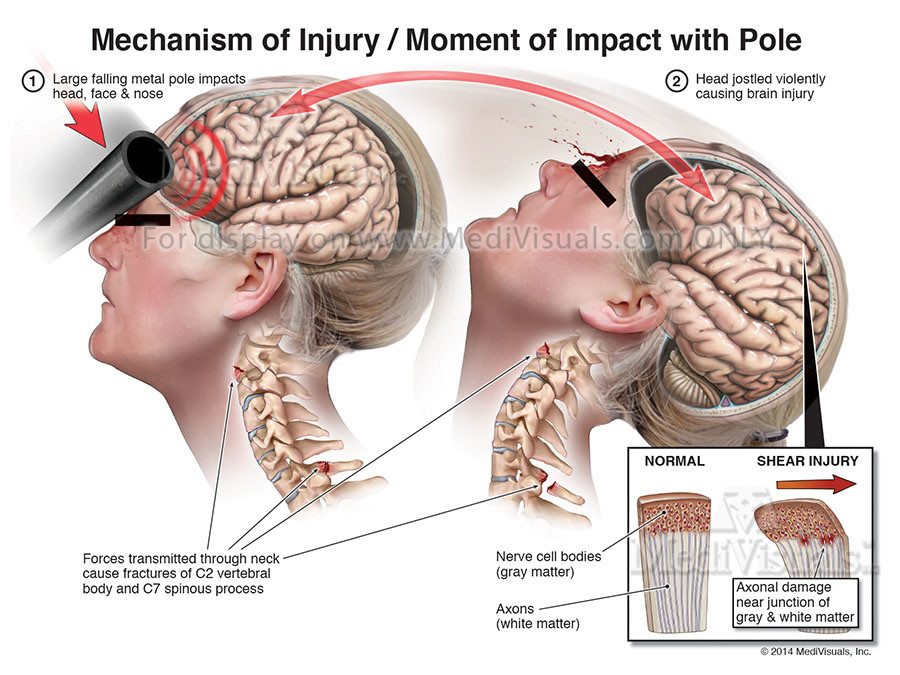
Medical illustration showing mechanism of injury following impact with a pole.
Proof That Strategic Litigation Graphics Work
Attorneys increasingly rely on data, verdict trends, and cognitive science to justify the investment in engaging graphics. The evidence is compelling and continues to grow.
A controlled study published in the Journal of Forensic Sciences found that 3D visual techniques improved juror understanding of technical language and, in turn, improved decision-making compared with photographs or no visual aids. Graphics improve information retention by engaging both visual and auditory processing, and visuals help jurors process complicated information quickly.
In a separate experiment involving 238 mock jurors, participants exposed to computer-generated animation of a party's version of events were significantly more likely to reach a favorable verdict than those shown only static visual aids or no visuals at all. The odds ratio for that shift was approximately 5:1, confirming the persuasive power of well-constructed courtroom animations.
Industry surveys also reflect the trend. In 2024, approximately 35% of law firms used outside providers for trial graphics, up from roughly 22.7% the prior year, representing more than 50% growth in outsourcing. A 2025 trial readiness survey found that 37% of respondents used a graphics partner for demonstratives and animations, and 41% reported conducting mock trials or focus groups to test visual materials before trial.
Proof of effectiveness shows up in multiple forms:
- Before and after comparison of a narrative with and without visuals, where the visual version consistently produces clearer understanding of causation among jurors
- Mock trial or focus group feedback identifying which visuals were most memorable and most persuasive
- Settlement movement after the introduction of key demonstratives in mediation, where carriers and opposing counsel reassess exposure after seeing compelling visual evidence
- Judicial comments on clarity of exhibits in written orders, where available in public records
Visual aids help jurors remember key facts during trials, and timelines help jurors track sequences of events and establish cause-and-effect relationships. Charts and graphs simplify large amounts of financial data and statistics. When the evidence is clear, the outcomes follow.
Who Litigation Graphics Are For
Litigation graphics are essential tools for any case where facts are technical, disputes are complex, or damages are significant. If your jury needs to understand something they have never seen before, visuals are not optional.
- Trial lawyers in personal injury and medical malpractice Medical illustrations clarify injuries in personal injury litigation. Visuals show standard of care, mechanism of injury, and long-term damages such as future surgeries or reduced life expectancy. Medical malpractice trial exhibits can illustrate pre- and post-incident anatomy, surgical step sequences, and injury progression with precision that testimony alone cannot achieve. Medical illustrations can be used as demonstrative aids in trials.
- Attorneys handling crash reconstruction and transportation claims Car crash animations, point of impact diagrams, and visibility analyses based on scene measurements and event data recorders help jurors understand speed, distance, force, and line of sight. 3D animations can illustrate complex scenarios such as vehicle crashes or product failures effectively.
- Product liability and industrial accident litigators These cases demand cutaway views, failure mode diagrams, warnings comparisons, and process flow charts for complex machinery. Product liability visuals help lawyers present technical concepts that would otherwise overwhelm jurors unfamiliar with engineering or manufacturing processes.
- Intellectual property and technology counsel Claim charts, technology tutorials for jurors, and stepwise process diagrams show how a device or software meets or avoids asserted claims. Data visualizations and flow charts can break down patent complexity into concepts a jury can evaluate and understand.
- In-house counsel and risk managers Visuals help communicate litigation exposure and strategy to corporate leadership before settlement conferences or major hearings. When decision-makers can see what a jury will see, they make more informed choices about risk.
Types Of Litigation Graphics We Create
Different case types require different visual tools. Often, the strongest visual strategy combines multiple formats into a cohesive sequence that builds understanding across the entire trial.
- Medical illustrations and anatomical sequences Surgical step visuals, injury progression diagrams, comparative anatomy showing pre- and post-incident conditions, and radiology overlays. These exhibits illustrate what happened inside the body with a level of detail and clarity that raw imaging cannot provide.
- Forensic and crash reconstruction animations Vehicle trajectories, speed and distance relationships, line-of-sight demonstrations, and environmental conditions such as lighting and weather. Animated graphics can demonstrate complex mechanics in scientific or legal contexts, and our forensic animations are built on physics-based data from scene measurements, EDR downloads, and damage profiles.
- Timelines and chronologies Treatment timelines, corporate knowledge timelines in product cases, incident lead-up sequences, and regulatory compliance histories. Timelines help jurors track sequences of events and establish cause-and-effect relationships across weeks, months, or years of activity.
- Technical diagrams and product cutaways Component labeling, exploded views, manufacturing process flows, and warnings or instructions contrasted with safe-use scenarios. These diagrams break down the complexity of machinery, devices, or industrial processes into clear, labeled visuals.
- IP and software process visuals Flow charts showing data movement through systems, side-by-side comparisons of prior art and accused products, and simplified patent claim breakdowns. Document callouts direct jurors' attention to specific evidence in contracts or emails.
- Damages and life care plan exhibits Cost breakdown boards, day-in-the-life sequences, vocational impact diagrams, and charts summarizing economic loss calculations. These exhibits make the financial impact of injuries concrete and understandable.
Types of litigation graphics include timelines, charts, diagrams, and 3D animations, and the most effective visual strategies use several of these formats in combination. Well-designed graphics can reinforce the credibility of a case by showing jurors that every claim is supported by organized, verifiable evidence.
Forensic animation showing ATV crash.
How To Integrate Litigation Graphics Into Your Case Strategy
Timing and placement of visuals across the life of a case often matter as much as the artwork itself. The most effective trial teams plan their visual strategy early and refine it continuously.
- Early case evaluation and mediation Use high-level graphics and short animations to test themes with colleagues or focus groups and to communicate risk to carriers. Even preliminary visuals can shift settlement dynamics when they make the strength of your evidence immediately visible.
- Discovery and depositions Use draft diagrams with witnesses to lock in testimony and refine how complex mechanisms or procedures will be explained at trial. Visuals simplify complex information while preserving evidence accuracy, and using them during depositions creates a record that aligns with your trial exhibits.
- Pre-trial motions and hearings Use simplified visuals in motion practice, such as claim charts in IP cases or timelines attached to summary judgment briefs. A judge reviewing a clear visual alongside a brief is more likely to grasp the factual foundation of your argument quickly.
- Trial openings and closings A small set of anchor graphics can structure the narrative: one master timeline, one key liability diagram, and one damages board. Visuals play a significant role in modern trial strategy for legal cases, and these anchor exhibits give jurors a framework to organize everything they hear. Visual aids can reduce cognitive overload for jurors during trials.
- Expert witness direct examination Build sequences of boards or animations that track precisely with the expert's outline, so every opinion is visually anchored to evidence. Courtroom visuals bolster expert testimony by giving jurors a reference point for each technical concept the expert explains. Graphics can keep jurors engaged during lengthy witness testimonies.
Pricing And Engagement Options
Costs for litigation graphics depend on complexity, the number of exhibits, the types of visuals required, and the timeline for production. Transparent scoping is critical in litigation budgets, and we work with trial teams to define scope early so that there are no surprises.
Foundational Package: Core Trial Graphics For Smaller Cases
This tier includes a limited set of medical illustrations, one to two timelines, and a small number of liability diagrams suitable for single plaintiff matters. It is ideal for straightforward auto collisions, slip and fall incidents, or focused malpractice questions. Typical turnaround is two to four weeks from finalized records, depending on the volume of source materials.
Comprehensive Package: Multi-Exhibit Visual Strategy
This package includes multiple exhibit types, such as medical, technical, and damages graphics, coordinated around a cohesive trial theme. It is well suited for complex medical malpractice, multi-vehicle crashes, industrial injuries, and mid-size IP disputes. Collaborative planning sessions with the trial team and experts are included to ensure every graphic serves the overall case narrative.
Custom Engagements For Large-Scale And Multi-Party Litigation
For national products cases, mass torts, or high-value patent disputes spanning multiple jurisdictions, we offer tailored scopes with phased budgets aligned to discovery stages, bellwether trials, or coordinated defense group visuals. Expedited production is available for last-minute hearings or newly discovered evidence, though clear deadlines are essential. These engagements leverage the full capabilities of our team, including our Adobe Creative Suite workflows, 3D animation pipeline, and video editing resources.
Frequently Asked Questions About Litigation Graphics
These are the questions attorneys most frequently raise during initial consultations.
How early should I involve a litigation graphics team in my case
The benefit of starting early is significant. During discovery planning, or even pre-suit in serious injury or complex technical cases, early involvement allows more accurate storyboarding, better use of visuals in depositions, and smoother expert coordination. Teams that identify visual needs early avoid the rush and higher costs that come with last-minute production under tight deadlines.
Are litigation graphics admissible as evidence, or only demonstrative
There is an important distinction. Animations typically function as demonstrative aids, offered to illustrate expert testimony. Courts expect them to be faithful to the witness's opinions, disclosed in advance, and not misleading. Simulations, by contrast, are treated more like substantive evidence and must satisfy the reliability framework under Daubert (federal and many state courts) or Frye (general acceptance standard in other jurisdictions). We work closely with counsel to ensure every visual is properly disclosed, supported by evidence, and framed for admissibility. Visual aids must simplify information while preserving evidence accuracy.
What information do you need from our firm to get started
We typically need pleadings, key deposition transcripts, medical records, diagnostic imaging, crash data, product manuals, and any existing expert reports. A concise case summary or trial theme memo can accelerate concept development. The more organized the source documents, the faster we can move from intake to concept sketches.
How do revisions and last-minute changes work
Standard engagements include defined rounds of revisions at each draft stage. Additional changes beyond those rounds are handled through a straightforward change-order process. Close to trial, we expect that courts may issue late evidentiary rulings or that new evidence may emerge. We plan capacity for rapid edits, but realistic time frames depend on the scope of the changes and how far into production the exhibits have progressed.
Can you support virtual hearings and hybrid trials
Yes. We produce formats optimized for screen sharing, remote platforms, and monitors in the courtroom. Our team coordinates with trial technicians and in-house technology consultants to ensure smooth display of animations and large exhibits on any screen or system used during litigation proceedings. As courts increasingly adopt hybrid and virtual components, we deliver materials that work seamlessly in every environment.
Animation showing cellular mechanism of lead injury.
Get Started With Litigation Graphics For Your Next Case
Visuals play a critical role in every high-stakes case where the facts are technical, the stakes are significant, and the jury needs to understand what happened and why it matters. Trial graphics simplify complex evidence into clear explanations, and that clarity drives better outcomes at mediation, in arbitration, and at trial.
Take a few minutes to audit your current case load and identify one or two matters where visuals could immediately clarify liability, causation, or damages. Even an early exploratory conversation with our team can shape your visual strategy and help you evaluate where the biggest opportunities for impact exist.
Contact MediVisuals + High Impact to schedule a consultation. Whether you are decades into your practice or preparing for your first complex trial, our team is ready to assist you in turning the evidence into a compelling, understandable story. You can also request sample visuals or a capabilities overview to share with colleagues during internal firm discussions.
Work with us
Interested in working with us? To get started choose one of the options below.