
October 26, 2026
Medical Demonstratives: A Practical Guide for Litigation Teams
-
Animation
-
Medical
-
Illustration
-
Medical Illustration
-
Legal
-
Insight
- +4

Medical demonstratives are visual tools that translate complex medical facts into clear demonstrative evidence for legal proceedings. Whether you are preparing for mediation, trial, or settlement negotiations, these visuals can shape how decision makers perceive injuries, treatment, and long-term prognosis.
Key Takeaways
- Medical demonstratives are visual demonstrative exhibits, not standalone proof. They must be tied directly to medical records, diagnostic imaging, and expert testimony.
- Common examples include surgical step illustrations, condition-progression timelines, colorized MRI and CT images, anatomical models, and medical animations tailored to the specific plaintiff.
- Well-planned medical demonstratives strengthen litigation strategy at every phase, from demand packages and mediation through trial and appeal. Visual aids can significantly influence case outcomes in trials.
- Visuals improve juror retention of information during deliberations, with studies suggesting recall jumps from roughly 10-15% with verbal-only presentation to 65-85% when visuals accompany testimony.
- MediVisuals + High Impact focuses on scientifically accurate medical animations, illustrations, and trial graphics to help attorneys present complex information persuasively and ethically.
What Are Medical Demonstratives?
Medical demonstratives are visual demonstrative aids that depict anatomy, pathology, and medical procedures for use in legal cases. They are a subset of demonstrative evidence created specifically to explain medical issues, not to replace underlying medical records or testimony. Medical demonstratives are visual aids used in legal, educational, and clinical settings, and they bridge the gap between complex medical concepts and clear understanding.
Common formats include:
- Medical illustrations and custom medical illustrations
- Medical animations showing injury mechanisms or surgical procedures
- 3D anatomical models, both physical and digital
- Enlarged and annotated diagnostic images (MRIs, CT scans, X rays)
- Procedure step-by-step graphics and condition-progression timelines
These demonstrative exhibits are typically used alongside treating-physician testimony, retained medical experts, and records such as operative reports and radiology studies. Although rules vary by jurisdiction, courts generally treat medical demonstratives as illustrative aids that help jurors understand complex information, provided they fairly and accurately reflect the evidence.
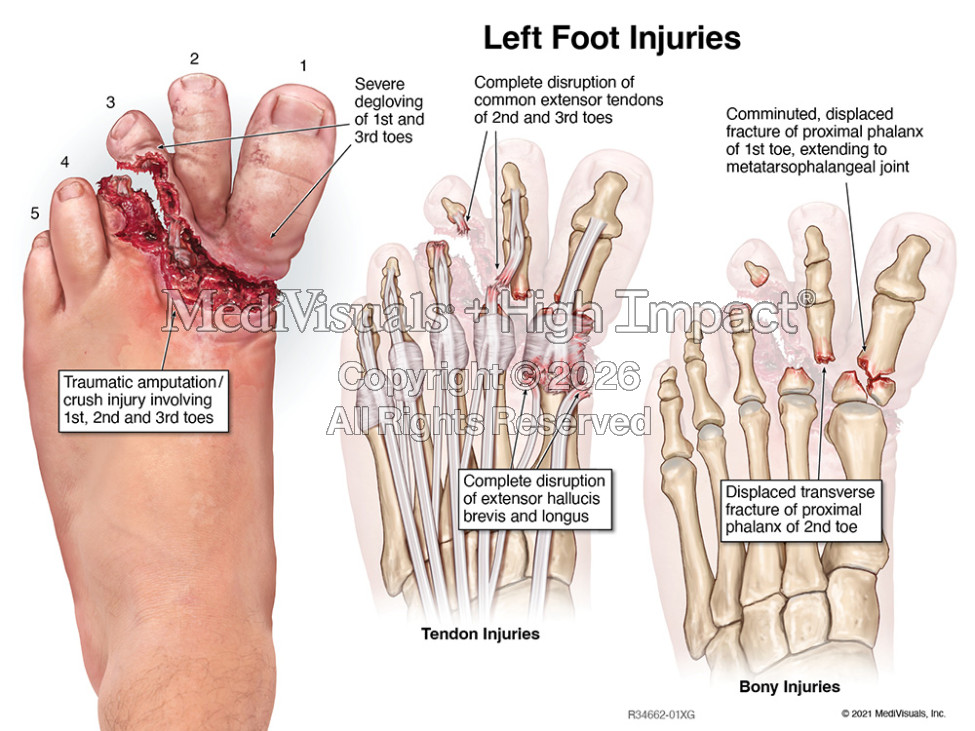
Medical illustration detailing severe toe injuries.
Demonstrative Evidence in Medical and Injury Cases
Medical demonstratives fall within the broader category of demonstrative evidence used in civil and criminal legal proceedings. The distinction between demonstrative evidence and real or substantive evidence matters: an actual implant device removed during surgery is substantive evidence, while a labeled 3D rendering of that device is a demonstrative aid designed to illustrate what the physician found.
Demonstrative evidence helps juries understand complex information and clarifies causation and damages in cases. In personal injury cases, medical malpractice cases, product liability matters, and crash reconstruction disputes, these visuals bridge the gap between dense medical records and juror comprehension. Demonstrative evidence includes charts, diagrams, and animations, all of which can make technical language accessible.
At a high level, the Federal Rules of Evidence govern admissibility. Rule 401 addresses relevance, Rule 403 balances probative value against unfair prejudice, Rule 702 sets standards for expert testimony, and the newer Rule 107 on illustrative aids (effective December 2024) formalizes how courts handle visual presentations. Demonstrative aids must be grounded in authenticated medical data and should never introduce speculative injuries, procedures, or outcomes unsupported by the record.
Common Examples of Medical Demonstratives
Attorneys and medical experts choose specific demonstrative exhibits based on case theory, injuries, and forum. Medical illustrators create drawings showing injuries or medical conditions for better comprehension, while types of medical demonstratives include anatomical models and 3D animations. Here are common examples:
- Spine injury illustrations showing herniated discs at C5-C6, C6-C7, matched precisely to the plaintiff's imaging
- Surgical animations that illustrate procedures and techniques, such as a laparoscopic cholecystectomy or multi-level cervical fusion
- Traumatic brain injury cross-sections depicting hemorrhage location and extent
- Condition-progression timelines mapping symptom onset, diagnostic imaging dates, surgeries, hospitalizations, and rehabilitation milestones
- Enlarged and colorized diagnostic images, such as CT scans of a subdural hematoma or MRIs of complete ACL tears, annotated to highlight key findings for the jury
- Lifetime medical cost projections, comparative range-of-motion charts, or pre- and post-injury functional capacity boards
Anatomical models, both physical and digital, let jurors see how implants, fractures, or degenerative changes relate to normal anatomy. Medical illustrations can depict specific injuries or surgical procedures with a level of clarity that raw imaging alone rarely provides.
Medical Demonstratives vs Other Demonstrative Aids
General demonstrative aids like accident scene diagrams, wage-loss graphs, or property damage photos serve different purposes than medical demonstratives. What makes medical demonstratives distinct is their reliance on clinical terminology, alignment with diagnostic imaging, and the need for closer collaboration with medical experts during development.
Compare a generic spine diagram used across many legal cases with a case-specific spine illustration that precisely matches the plaintiff's MRI findings and operative notes. Custom medical illustrations support expert testimony in court cases because they reflect the actual patient, not an off-the-shelf template. Medical demonstratives must meet a higher expectation of medical accuracy because they visually represent internal anatomy and pathophysiology that jurors cannot see directly.
In complex legal cases, trial attorneys may combine medical demonstratives with other demonstrative evidence. A crash reconstruction animation might be followed by a mechanism-of-injury animation showing what happened inside the body on impact. Trial graphics clarify complex evidence for jurors, and high-quality trial graphics signal professionalism and preparation.
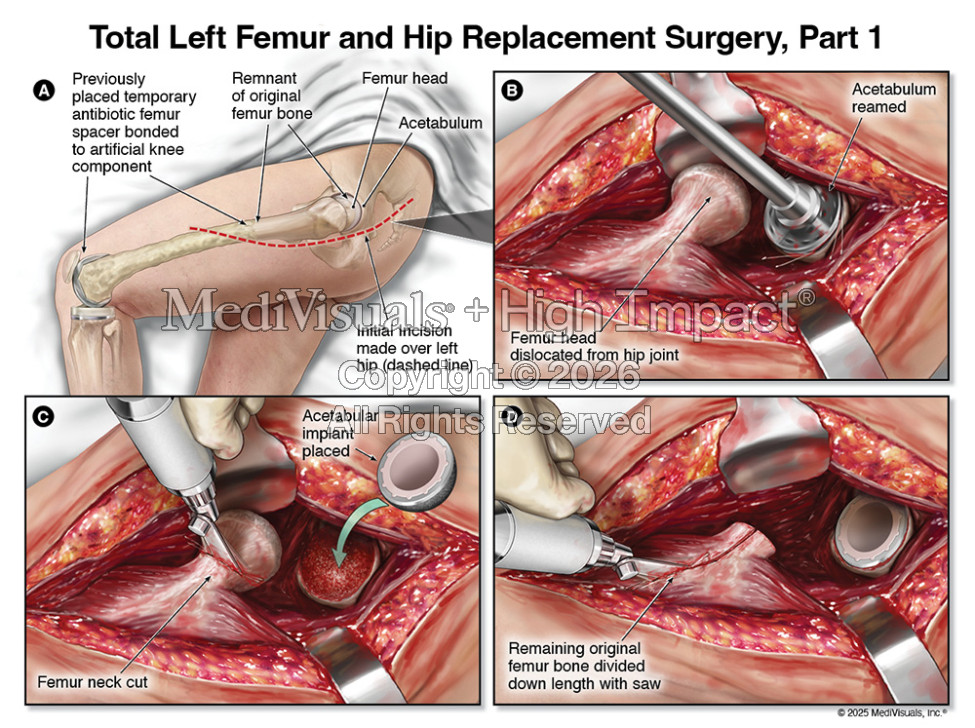
Medical illustration showing total femur and hip replacement surgery.
Types of Medical Demonstratives Produced by MediVisuals + High Impact
MediVisuals + High Impact provides a full suite of visual media for medical, technical, and legal evidence presentation. Services include:
- Medical illustration: custom single-plate illustrations, surgical series showing each operative step, and condition-progression sequences from pre-injury baseline through long-term complications. Medical illustrations clarify complex medical conditions for juries.
- Medical animations: depicting biomechanics of impact, surgical interventions such as spinal fusion or joint replacement, and device failures in product liability matters. 3D simulations can demonstrate complex anatomical relationships.
- 3D interactive exhibits and anatomical models: allowing rotation, transparency, and layering for orthopedic, neurosurgical, or cardiac cases. Interactive 3D tools teach anatomy and procedural context effectively.
- Integration with crash reconstruction, environment and product liability visuals, and intellectual property visuals when medical issues intersect with engineering or design disputes.
All deliverables can be adapted for printed trial boards, digital slide decks, video for remote proceedings, and interactive elements for in-court presentation systems.
Using Medical Demonstratives Across the Life of a Case
Medical demonstratives are strategic tools throughout litigation, not just at trial. Visual aids can bridge gaps between accidents and resulting harm at every stage of the process. Here is how they support each phase:
- Demand packages: Early concept sketches or simplified boards clearly depict injuries, surgeries, and future care for opposing counsel and insurers before suit is filed.
- Mediation: Medical animations help decision makers grasp long-term disability, chronic pain, and loss of function, often influencing settlement ranges. Medical demonstratives help patients understand diagnoses and treatment options, and they improve informed consent by enhancing patient understanding.
- Depositions and expert testimony: A physician can walk through each step of a multi-level cervical fusion with synchronized illustration panels. Medical illustrations support expert testimony in personal injury cases.
- Trial: Sequencing demonstratives with lay and expert witness testimony, using timelines to orient jurors, and revisiting compelling visuals during closing arguments all strengthen case presentation. Trial graphics can evoke empathy and emotional engagement from jurors. Visual aids enhance juror retention and recall of information.
- Post-trial and appellate: Still frames from medical animations or key diagrams can appear in appellate briefs where rules allow visual presentations.
Design and Accuracy Principles for Effective Medical Demonstratives
Design choices directly affect admissibility, credibility, and juror understanding. Accurate visuals clarify complex medical information for jurors, but only when grounded in verifiable source materials.
Start from authenticated records: radiology imaging, operative reports, pathology findings, and treating-physician notes. Medical illustrations must be developed with medical expert consultation to maintain scientific integrity. Visual aids clarify complex medical evidence in legal cases, and demonstrative exhibits help jurors understand medical conditions better.
Best practices for visual clarity include:
- Limited color palettes that highlight pathology without overwhelming the viewer
- Legible labels with consistent anatomical orientation (always marking left vs right)
- Clear flagging of assumptions, such as labeling hypothetical future surgeries or projected degeneration so they are not misinterpreted
- Iterative review with counsel, medical experts, and technical artists to ensure visual content tracks precisely with the record
Attorneys should evaluate demonstratives from a skeptical perspective, anticipating cross-examination challenges focused on accuracy and methodology. Visuals improve juror retention of information during trials, but only if opposing counsel cannot undermine their foundation.
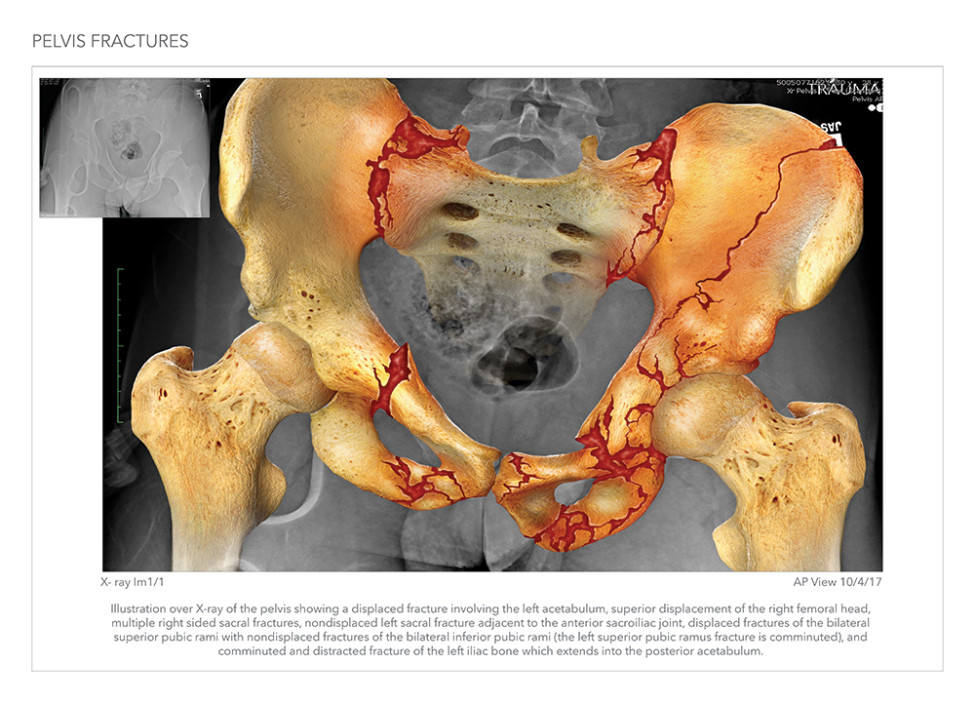
Medical illustration enhancing pelvic xray.
Legal and Ethical Considerations for Medical Demonstratives
While MediVisuals + High Impact does not provide legal advice, medical demonstratives must be prepared with awareness of evidentiary rules and ethical duties. Demonstrative evidence must accurately represent the underlying facts. Key considerations include:
- Relevance and prejudice: visual exhibits must illustrate facts in evidence without creating unfair prejudice or juror confusion
- Demonstrative vs substantive: distinguish between demonstrative aids used to illustrate expert testimony and visual evidence offered as substantive evidence, particularly when animations depict contested event sequences
- Pretrial procedure: attorneys should consider motions in limine, stipulations, or court conferences regarding proposed medical animations and anatomical models before using them with a jury
- Ethics: avoid exaggerated injury depictions, respect patient privacy by de-identifying materials, and ensure stock images are modified to accurately reflect the specific plaintiff
For detailed rule language, consult primary resources such as the Legal Information Institute at Cornell Law School.
How MediVisuals + High Impact Supports Litigation Strategy
MediVisuals + High Impact partners with litigation teams handling medical malpractice, catastrophic personal injury, product liability, intellectual property disputes involving medical devices, and other legal proceedings with medical components. The typical engagement process moves from initial case consultation and review of medical records, through storyboard development, to delivery of final medical animations and exhibits ready for court.
Collaboration with expert witnesses, crash reconstruction professionals, and other specialists ensures that visual storytelling remains tightly aligned with case strategy and the evidence. The firm can support exhibit planning for state and federal courts, arbitrations, and remote or hybrid legal proceedings, tailoring formats accordingly.
Early involvement allows attorneys to refine themes, test visuals with focus groups, and create custom medical illustrations that integrate seamlessly into the client's story and overall litigation strategy.
Frequently Asked Questions about Medical Demonstratives
How early in a case should we start developing medical demonstratives?
Work can begin as soon as key medical records, diagnostic imaging, and preliminary expert opinions are available. Starting at least several months before mediation or trial allows time for concept development, medical review, revisions, and any necessary court challenges. Early drafts can be simplified for demand packages, then refined for later trial exhibits.
What source materials are needed to create accurate medical animations and illustrations?
Core materials include hospital and clinic records, operative reports, radiology reports, DICOM files for CT and MRI scans, physical therapy notes, and photographs of scars or external hardware. Having final medical opinions, such as permanent impairment ratings, helps ensure demonstratives reflect the complete medical picture. Attorneys should provide any existing visual aids or prior imaging for consistency across exhibits.
Can the same medical demonstratives be used in multiple legal proceedings?
Case-specific demonstratives are often reused in related contexts, from pre-suit negotiations through mediation, trial, and post-trial hearings, provided the underlying evidence does not change. Updates may be needed when new surgeries, complications, or imaging findings arise. Maintaining editable source files allows efficient revision rather than recreation.
How do courts typically view medical animations that depict how an accident occurred?
Courts scrutinize event-sequence animations closely because they can appear to show exactly how an incident happened, even when details are contested. Plaintiff and defense attorneys should clearly label such animations as illustrative, base them on documented facts and expert opinions, and discuss any assumptions transparently. Seeking pretrial rulings on permissible use is essential.
What is the typical turnaround time for high-quality medical demonstratives?
Simple single-image medical illustrations can sometimes be produced within a few weeks. Complex 3D animations or interactive exhibits may require several months from concept approval to final delivery. Sharing key litigation dates, such as disclosure deadlines and trial settings, helps the visual team schedule milestones and deliver services on time. Early engagement provides more flexibility and better strategic integration into the case.
Work with us
Interested in working with us? To get started choose one of the options below.