
September 25, 2026
Medical Legal Illustration: Turning Complex Medicine Into Persuasive Evidence
-
Illustration
-
Medical Illustration
-
Legal
-
Insight
- +2

Medical legal illustration translates complex medical data into clear visuals that attorneys, jurors, and adjusters can understand in seconds. This article covers when to use custom case specific illustrations versus stock exhibits, how to collaborate with a medical illustrator, and how to integrate these visuals into your trial or mediation game plan.
Key Takeaways
- Medical legal illustrations convert findings from X ray films, CT scans, MRIs, and operative reports into visuals a jury can grasp without medical training.
- MediVisuals + High Impact creates medically accurate medical illustrations, animations, and 3D models for personal injury and medical malpractice cases.
- Effective legal illustration is simpler than textbook medical illustration; it is designed to support expert testimony and meet evidentiary standards for demonstrative evidence.
- Visuals can be created directly from medical records, diagnostic imaging, and surgical records for both plaintiff and defense teams.
- Custom illustrations can impact trial outcomes by making injuries, surgeries, and mechanisms of injury visible to non-physicians.
What Is Medical Legal Illustration and Why It Matters
Medical illustrations created for litigation serve a different purpose than those found in anatomy textbooks or clinical education materials. Where textbook images explain human anatomy and medicine for students, medical legal illustrations depict a specific patient's injury, pathology, or surgical procedure using that patient's own imaging studies and medical records. They are demonstrative evidence, visual aids that help explain complex medical concepts so a lay audience can follow along.
Medical legal illustrations are used in personal injury, medical malpractice, and product liability cases to clarify injuries, mechanisms of injury, and complex surgeries. Visual storytelling simplifies medical narratives for juries. Research on courtroom communication confirms that visuals help jurors retain information compared to verbal testimony alone. Trial graphics enhance jury understanding of complex medical issues by making pathology and normal anatomy visible side by side.
Consider a 2024 traumatic brain injury case: a colorized CT scan with overlays showing midline shift and intracranial hemorrhage, derived from DICOM files, allowed jurors to see displaced brain tissue in context. That kind of clarity turns abstract radiology into something the jury remembers during deliberation.

Medical Illustration Showing Retraction Injury During Cervical Surgery
From Films To Visuals: Working With X Rays, CT Scans, and MRIs
Raw radiology is grayscale, dense, and full of nuance that takes years of training to read. Jurors and judges cannot discern a hairline fracture or a herniated disc from a standard X ray or MRI without help. Medical legal illustrations are created from diagnostic films and reports to bridge that gap.
The process starts with DICOM files, radiology reports, and treating physician notes. Illustrators enlarge views, add colorization to highlight fractures or herniations, and overlay anatomical context, such as nerve roots adjacent to a disc herniation or vessels near a hemorrhage. In a spinal cord compression case, for example, colorizing the herniated disc material pressing on the dura makes the injury immediately visible.
Medical legal illustrations must be scientifically accurate to be admissible in court. Illustrations that clarify the mechanism of injury in accidents or depict surgical errors need authentication by a medical witness who confirms the visual matches the original film and the patient's records. In Snowden v. Ekeh, an Ohio appellate court found that sending a medical drawing to the jury without proper foundation risked giving excessive weight to the image.
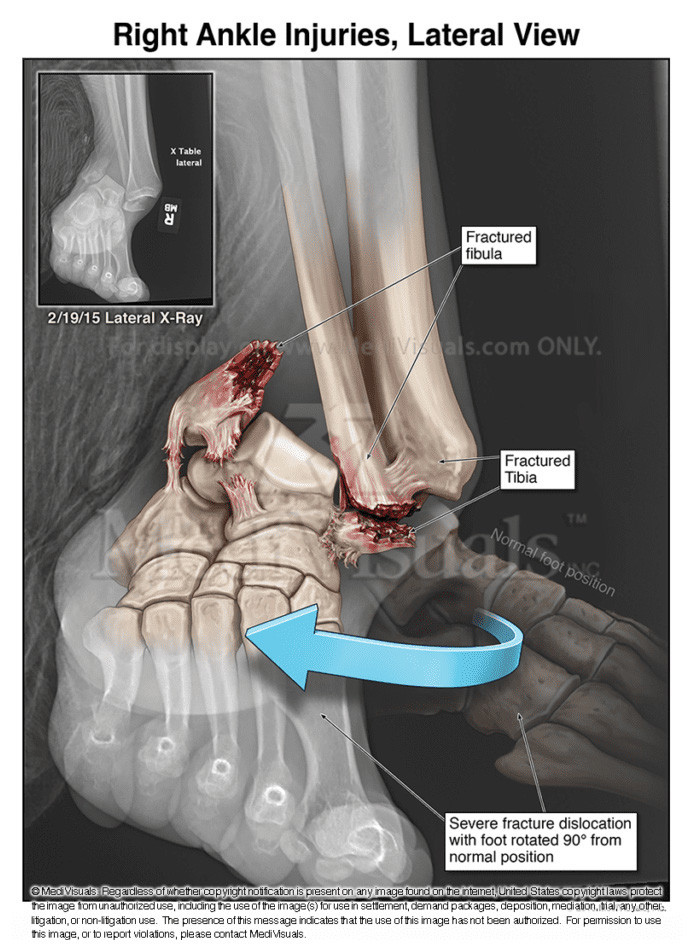
Colorized X-ray showing severe ankle fracture
Types of Medical Legal Illustrations Used in Litigation
The range of medical demonstratives involved in personal injury cases and medical malpractice litigation extends well beyond a single diagram. Different case types call for different visual approaches.
- Surgical sequence illustrations walk through key steps in a procedure, such as spinal fusion or C-section, tailored to how the injury occurred or where a standard of care deviation took place. Illustrations can depict injuries and surgical procedures accurately, clarifying each step for lay audiences.
- Mechanism of injury visuals demonstrate how forces acted on the body. In a rear-impact collision, for instance, a visual showing cervical hyperflexion and resulting disc herniation helps explain common injuries and uncommon ones alike.
- Comparative anatomy panels contrast normal anatomy with the injured state, such as a healthy lumbar disc next to an L4-L5 herniation compressing the nerve root. Illustrations comparing healthy versus injured anatomy highlight the extent of trauma.
- Medical devices in situ show pedicle screws, hip implants, or cardiac stents relative to surrounding anatomy, helping juries understand long-term consequences.
- Animations reveal hidden anatomy beneath the skin and clarify complex medical procedures. Both 2D and 3D medical animations serve as visual aids for expert testimony. Crash reconstruction uses 3D models to depict accidents, and crash reconstruction visuals help juries understand complex cases.
Stock medical illustrations cover common anatomy and procedures. Case specific illustrations, by contrast, are built from the client's own imaging, operative reports, and physicians' notes.
Custom Medical Legal Illustrations vs Stock Exhibits
Stock anatomy diagrams are fast and affordable. For low-exposure soft tissue claims where basic spinal or joint diagrams meet the need, they can work. Custom case specific illustrations, however, are built from a patient's own operative reports, intraoperative photos, and physician notes. In high-exposure medical malpractice cases, complex orthopedic reconstruction, or wrongful death cases, custom work shows the jury what happened to this patient, not a generic body.
A 2025 birth injury case, for instance, required a detailed obstetric sequence illustrating labor, fetal distress, interventions, and resulting palsy. No stock image could convey that progression with the specificity needed for a jury to understand causation. Case-specific illustrations can impact trial outcomes precisely because they are tied to the record. High-quality visuals can also drive settlement negotiations by presenting the severity of injuries with clarity that an adjuster cannot dismiss.
MediVisuals + High Impact integrates both approaches, pairing stock normal anatomy with targeted custom panels to control cost while preserving accuracy and detail.
Collaborating With Medical Illustrators in Personal Injury and Medical Malpractice Cases
The strongest medical legal illustrations result from close collaboration among attorney, medical witness, and illustrator. Effective trial graphics require that collaboration from the start.
Attorneys should provide the most complete set of materials available: emergency department records, X ray and CT scan images, MRIs, radiology reports, operative reports, rehabilitation notes, relevant photographs, device specifications, and a timeline of care. The more detail the team has, the more accurate the final product.
The typical workflow moves from initial case review and sketch concepts, through physician review for medical accuracy, to final color art or animation ready for trial presentation. Visuals are aligned with key legal issues. In a delay-in-diagnosis cancer case, for example, the illustration might map symptom onset against diagnostic milestones to demonstrate causation. In a catastrophic burn case, it might illustrate extent of injury across the body.
MediVisuals + High Impact maintains neutrality in depiction. Visuals are created from medical records and expert testimony to ensure relevance and accuracy, producing fact-based exhibits that withstand cross-examination from medical experts on the opposing side.
Using Medical Legal Illustrations Effectively at Mediation and Trial
Legal illustration is most powerful when strategically integrated into opening, direct examination, and closing, not treated as an afterthought. Custom illustrations assist attorneys in communicating during both mediation and trial by giving the audience a visual reference they can follow.
Pair original imaging with the corresponding medical legal illustration so the medical witness can walk the jury from film to clarified visual. During direct examination, synchronize surgical step illustrations with the surgeon's narrative. Animations serve as visual aids that explain complex medical conditions step by step, making the knowledge accessible to specialists and non-specialists alike.
At mediations and settlement conferences, visuals shape negotiations before a case reaches a jury. Even a concise set of panels showing a plaintiff's injuries and the surgical procedure involved can shift an adjuster's evaluation.
Technical considerations matter: ensure high-resolution prints for courtroom display and digital files compatible with modern presentation platforms. Avoid overloading jurors with too many exhibits at once. Group related visuals, limit what is on screen at any moment, and time your most critical images for opening and closing when attention is highest.
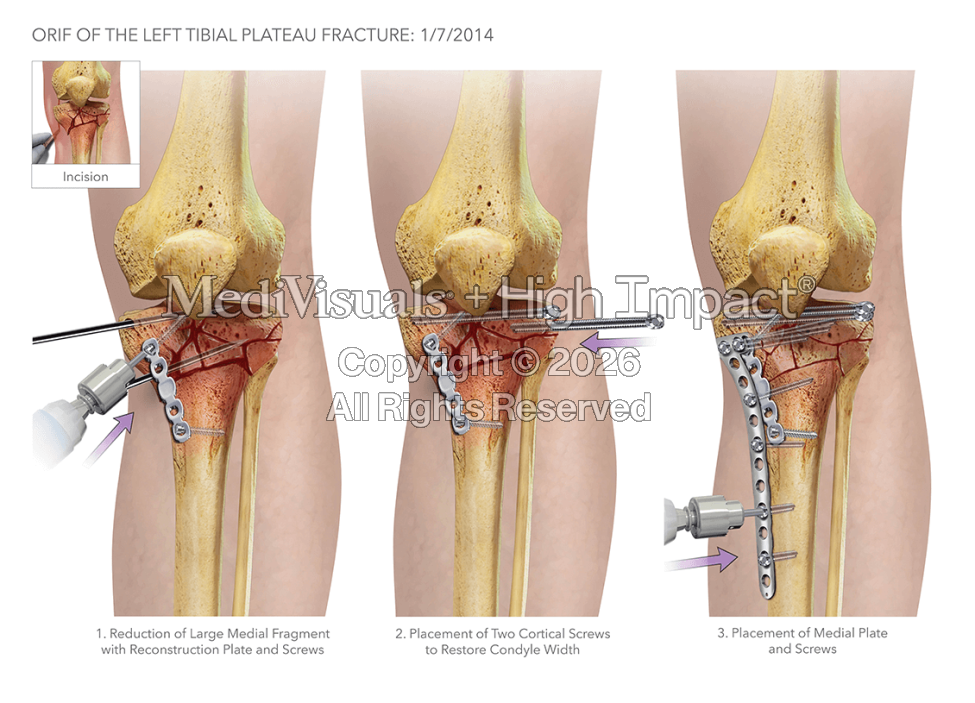
Medical illustration showing open reduction internal fixation of tibial plateau fracture
Why Work With MediVisuals + High Impact for Medical Legal Illustrations
MediVisuals + High Impact is a litigation support provider focused on scientifically grounded visual storytelling for medical legal cases. The team handles complex medical subject matter across neurosurgery, orthopedics, cardiology, obstetrics, and product liability involving medical devices.
Services extend beyond static illustrations to include legal animation, 3D interactive models, crash reconstruction, and trial graphics that integrate medical and technical evidence. Highly trained medical illustrators work alongside treating physicians through multiple review stages to keep every exhibit medically accurate. All work relies on current medical literature, imaging studies, and the patient's own records.
MediVisuals + High Impact supports both plaintiff and defense teams nationwide. All case materials are handled in compliance with privacy and confidentiality requirements. If you have an upcoming personal injury or medical malpractice case that could benefit from visual support, contact the team to discuss your needs and develop a visual strategy tailored to your case.
Frequently Asked Questions About Medical Legal Illustration
How early in a case should I involve a medical illustrator?
Attorneys get the best results when they engage a medical legal illustration team shortly after receiving key imaging and operative reports, often during discovery. Early involvement allows time for clarifying discussions with medical witnesses and for refining visuals that align with evolving case theories and scheduling orders. Waiting until trial preparation compresses timelines and limits revision cycles.
Can medical legal illustrations be used for both plaintiff and defense cases?
Yes. Medical legal illustrations are neutral tools. For defense, visuals might focus on preexisting conditions, alternative mechanisms of injury, or accurate depiction of appropriate standard-of-care procedures. MediVisuals + High Impact works on both plaintiff and defense matters in personal injury and medical malpractice litigation.
What materials are required to create medically accurate illustrations?
Core items include X rays, CT scans, MRIs, radiology reports, operative notes, clinic and hospital records, and any relevant photographs or device specifications. Providing a chronology summary helps the illustrator understand the progression of injury and treatment. The more complete the record set, the more precise the final illustration.
Are medical legal illustrations admissible as evidence in court?
Courts generally admit medical legal illustrations as demonstrative aids when a qualified medical witness authenticates the underlying records and confirms the visual accurately reflects the medical facts. Attorneys should consult current rules of evidence and applicable case law in their jurisdiction and work with their illustration provider to address admissibility concerns before trial.
What is the difference between a 2D illustration and a 3D model in litigation?
A 2D medical illustration is a static image suited for printed boards and presentation slides. A 3D digital model can be rotated, exploded, or animated to show anatomy and devices from multiple viewpoints. 3D models are useful for complex spinal constructs, cranial surgery, and product liability matters. 2D illustrations often work well for straightforward fractures and soft tissue injuries where a single viewing angle provides sufficient clarification.
Work with us
Interested in working with us? To get started choose one of the options below.